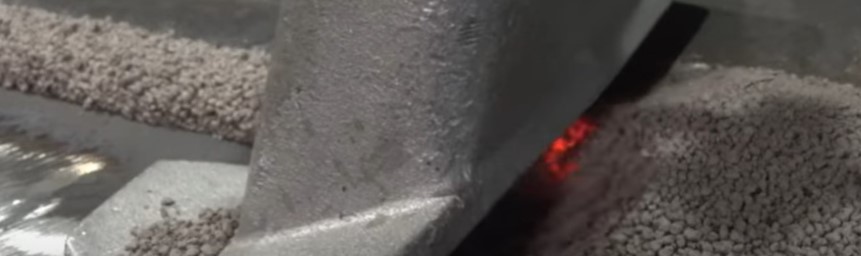
Submerged Arc Welding
Submerged arc welding (S.A.W. welding) is a welding technique that utilizes a granular powder continuously fed from a hopper through a welding gun. The powder creates a protective layer over the weld, shielding it from the atmosphere and preventing oxidation and other forms of contamination. Quite different from manual welding, which is how we test our people.
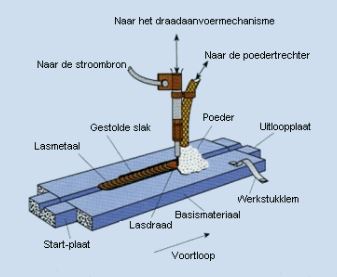
Schematic drawing of an S.A.W. setup.
To be able to apply this welding method, special, often large machines are required. Several large companies such as SIF use multiple of these machines for welding the poles used for wind turbines. As these companies will need multiple S.A.W. operators for the foreseeable future and candidates for this role are difficult to find, the idea arose to train them ourselves.
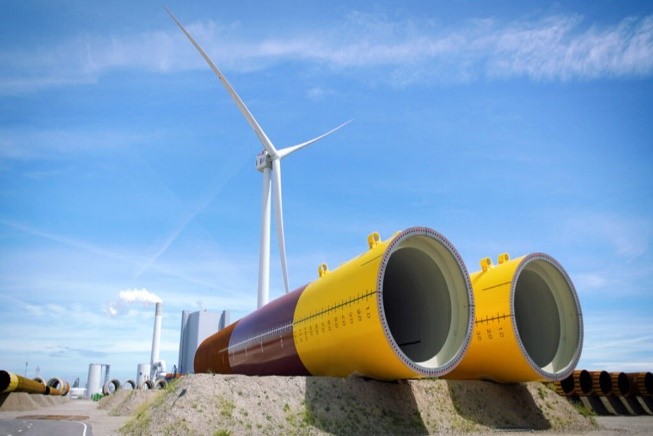
The enormous poles to be welded.
But how do you do that if you don't have an S.A.W. machine at your disposal?
Covebo Sliedrecht has consulted with the welding school Elektrolas in Waalwijk to see if there are any S.A.W. machines available that can be used to train our Covebo candidates. This has led to a collaboration with Certilas in Huissen, where a fine S.A.W. machine is set up in a hall, Elektrolas has developed the theoretical training, Pieter trains the candidates, and Covebo Sliedrecht takes care of the candidates themselves.
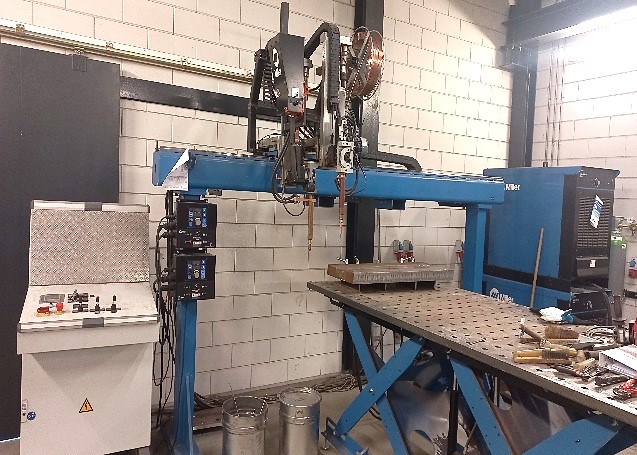
The S.A.W. setup for training purposes.
This training consists of a four-day program covering various areas. First, theory about this welding process, followed by a morning of MAG welding, and of course, most of the time is spent operating and welding with the S.A.W. welding machine. The aim is that after this training, the candidates' basic knowledge is sufficient for them to start at SIF. At SIF, they will then receive an additional internal training of approximately one month before they are allowed to weld the large poles in practice.
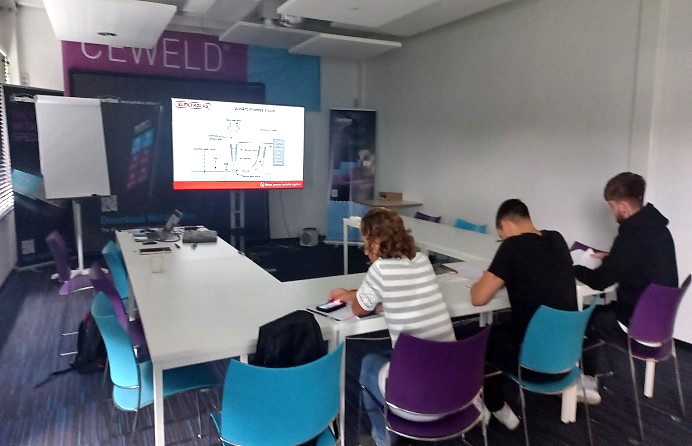
The theory lesson O.P. welding.
For the candidates, it is not necessary to be experienced MAG welders. It is more about being able to operate a machine than actually making a weld. However, to get some experience with welding, a basic training in MAG welding is provided with some theoretical explanation about it. The most important part of the entire training is, of course, learning to operate the O.P. machine.
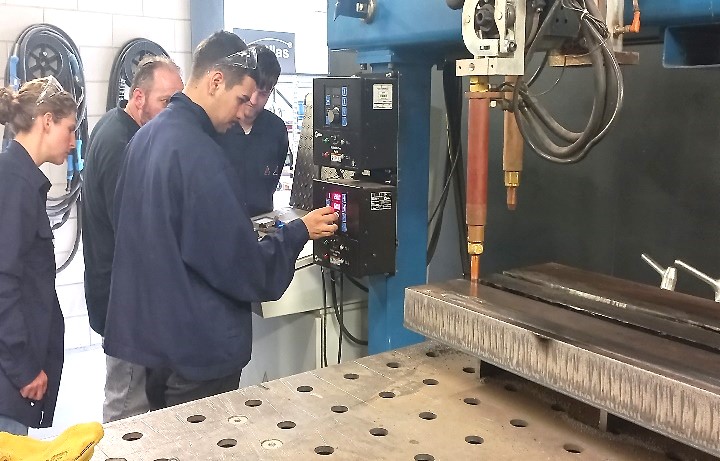
Training on the machine.
For the test, a 60mm thick plate with two deep grooves is used. This seam is over a meter long and must be completely welded. To do this properly, the machine's travel direction must be well adjusted and the welding parameters must be perfectly set. Manual MAG welding uses approximately 240 Amps of current, but the O.P. machine must be set to at least 650 Amps to achieve a neat, clean weld. The pre-adjustment is extremely important because you cannot check if everything is going well during welding. The entire process takes place under the protective powder layer. Only afterwards, after removing the remaining powder, can it be seen if the weld was successful.
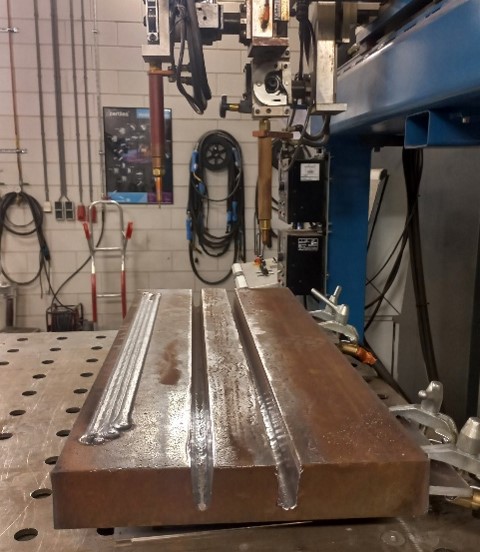
Deep grooves to fill.
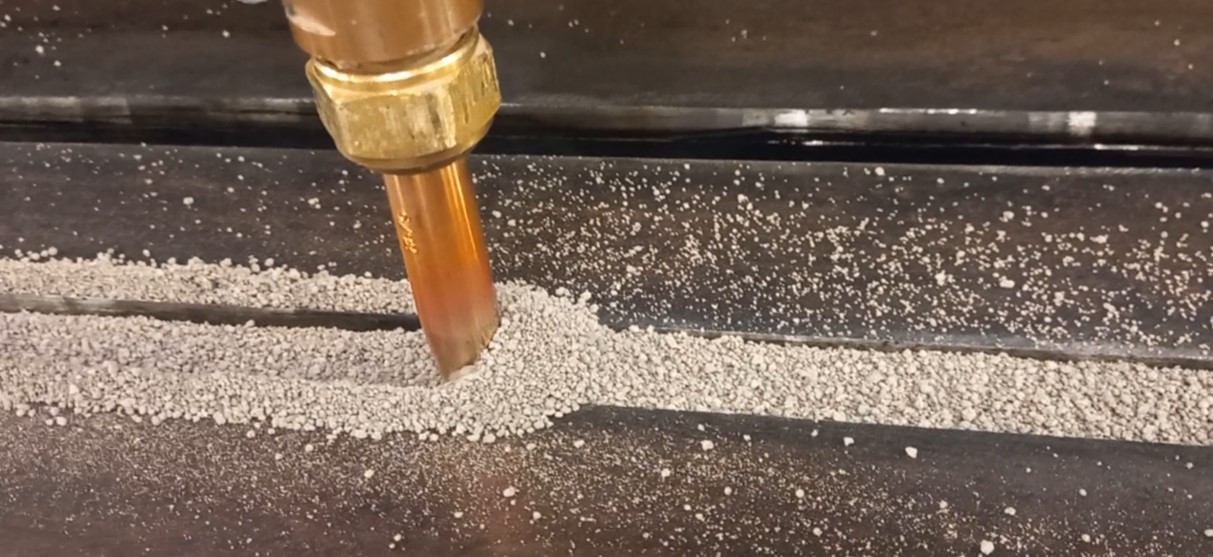
Welding under the powder.
Because O.P. welding takes place under a thick layer of powder, it is an extremely safe method of welding. There is no heat release, no bright light, and almost no noise.