
click where you want to go:
1. Certified welders:
2. Certificate validity:
a. The expiration date
b. The semi-annual stamp
c. The origin of the document
d. The welding area of the document
3. Certification costs:
How does a certificate work?
More and more often, when visiting construction companies, you notice that they ask for certified
welders.
In the Netherlands, the regulations are such that if you make constructions that will ultimately be
used by people, the welding work must be certified.
This applies, for example, to steel structures for office buildings, bridges, stairs, roof spans at
stadiums, or train platforms.
In short, anything where people could be seriously injured if something goes wrong.
The information below can be useful if you deal with such companies and want to know a little more about certification and what it all involves.
1. Certified welders
How do you know in advance if a company needs certified welders?
For every business visit, especially with new customers, it is useful to be able to estimate in advance what level of welding is required.
It makes a big difference whether it is simple welding work, such as waste containers where quality is not so important, or steel structures where quality is of the utmost importance.
This is the case, for example, in the production of bridges, airplanes, pressure vessels, gas pipelines, ship hulls, and so on.
If the quality requirements are so high, it is even more important to discuss which type of welder is needed and what certificates this welder must have. It is therefore crucial to know in advance what kind of welders are needed.
Almost every company that works under certification mentions this on its website. It is often
indicated for which industries they work, such as offshore or the oil and gas industry.
Also, information is often given about the way the company is certified:
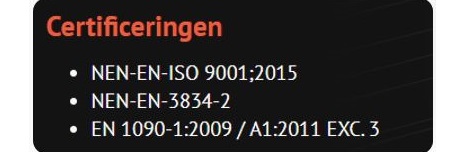
For example, NEN-EN-ISO 3834-2 is an internationally recognized quality system for welding, indicating that this company has all the knowledge to work with certified welders.
In the last line, EXC.3 is indicated. Execution class 3 - then you already know that the welders must be certified!
Another example is Breman Machinery.
This company places the highest possible demands on their welding work, and the welders need at least 3 welding certificates, in addition to a lot of experience, to be able to work there.
The following can be found about this on their website:
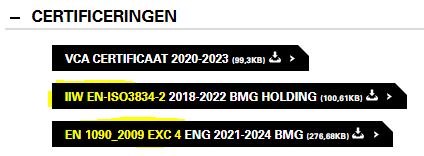
Again, the 3834-2 standard is mentioned, and also here the EXC class is mentioned. In this case, EXC class 4: the strictest standard in the field of welding.
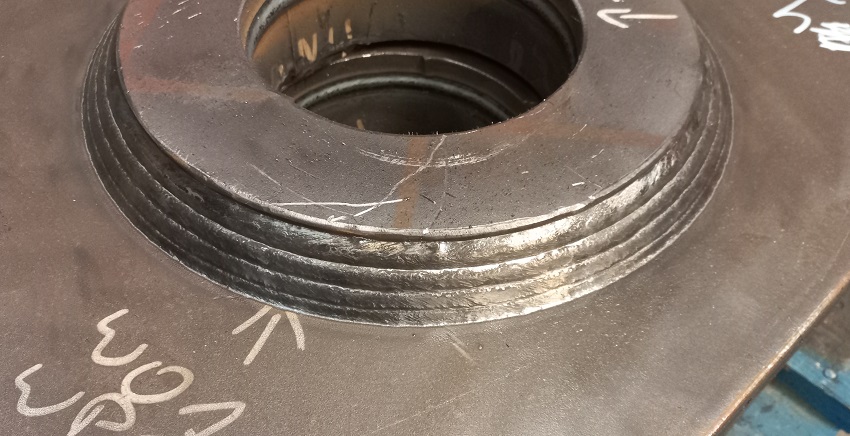
In the photo, you can see a weld as it regularly appears at Breman. Beautiful multi-layer technique welded by a certified welder. All in all, good to know what you are getting into, these welders are harder to find and will also be tested more rigorously in welding school.
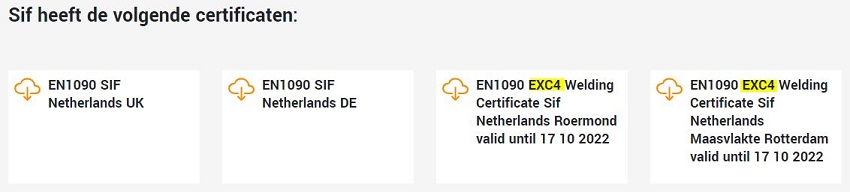
Example website Sif Group
2. Certificate validity
When is a certificate valid or not?
There are several important factors that determine whether a welder qualification (WK) is valid or not:
2.1 The expiration date
A welding certificate in Europe is issued according to EN ISO 9606-1.
This standard states, among other things, that such a certificate can have a validity period of 2
years (9.3b) or 3 years (9.3a).
At the bottom of the certificate, the test day and the date when the certificate expires are
mentioned.
A three-year certificate expires after the expiration date. If you want to continue using it, you
will need to take a new exam for a completely new certificate.
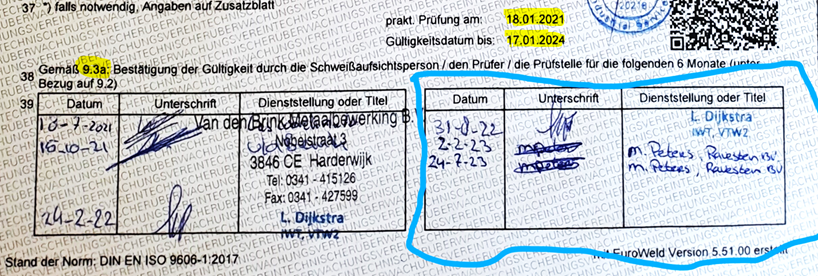
9.3a certificate: valid for 3 years.
A two-year certificate can be extended after the expiration date if all the necessary papers and stamps are actually present. All these documents are then sent to, for example, DNV.
They check everything and can then put a stamp for a new validity of two years.
A rather cumbersome method, especially for our temporary workers, because they never have all the associated documents.
An easier method is the 3-year certification.
The welder obtains a certificate and it is valid for three years.
Often, they do not even need it for three years as they have moved on to another job in the meantime.
A welding certificate is also often referred to as "WK" (Welders Qualification)
2.2 The Half-Year Stamp
If welding needs to be done under certification in the Netherlands according to the standards
NEN-EN-ISO 3834-2 or the Exc class, there must be a stamp on the document every six months in
addition to the validity date.
This stamp is a six-month confirmation from a company that it still welds according to the
certificate.
The problem with our welders is that even though they have a certificate, they often have no idea
that this needs to be stamped regularly. They never get this information in Poland.
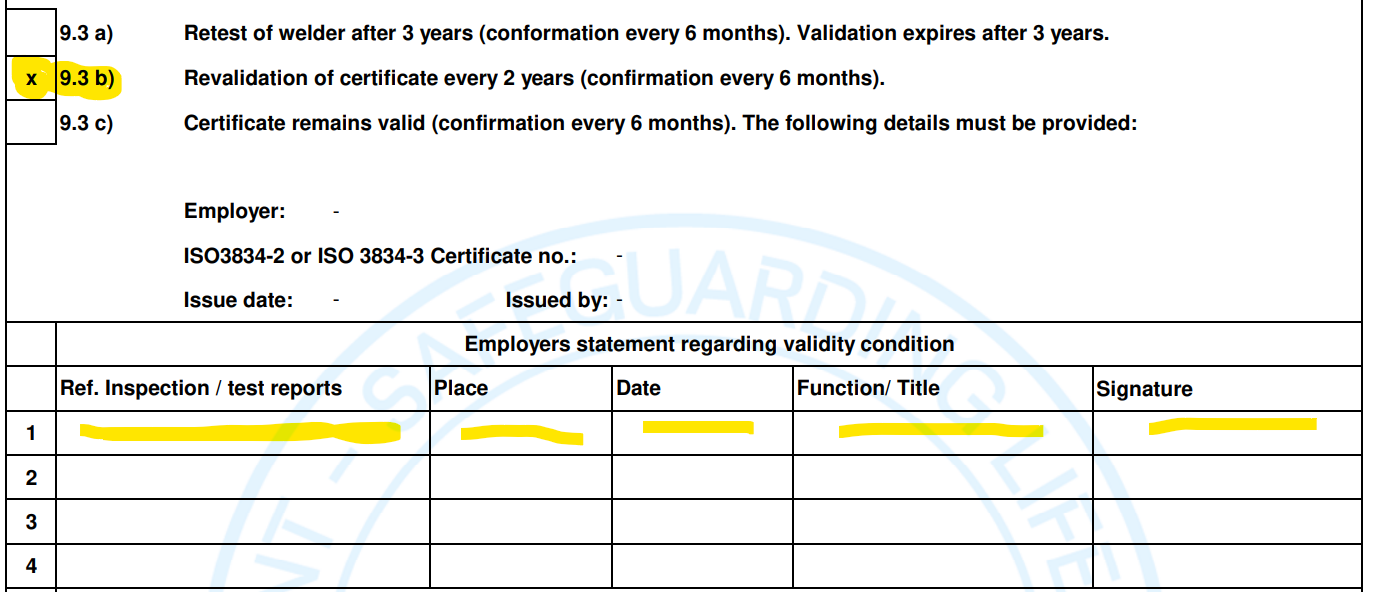
9.3a and 9.3b need to be signed off every six months.
So a certificate without stamps is only valid for the first six months after the exam day, after which the validity expires.
2.3 The Origin of the Document
There are numerous institutions where you can obtain a welding certificate.
However, most companies in the Netherlands have their own preference for certified institutions that
they know to be good and reliable.
Often these are documents from well-known European institutions, such as DNV (as in the example),
Lloyds, TUV, or NIL.
It is important that a LK also has the accompanying documents as proof of validity.
In the example below, you can see a LK from one of our guys obtained here in the Netherlands and
issued by DNV.
You can see all the other documents needed to obtain a certificate alongside the
LK.
The lack of these extra documents and stamps often results in Polish or other certificates not being
accepted.
2.4 The Welding Area of the LK
If a Covebo welder has a valid certificate, you also need to check if it covers the same welding area
as what is being welded at the customer.
For instance, a TIG certificate is useless if only MAG welding is being done.
There are also different types of MAG welding such as 135, 136, and 138.
An LK for stainless steel is not valid for steel, and the dimensions of the test piece must
reasonably match the customer's product to be welded.
The chances of a certificate being accepted are therefore quite small.
Download example LK:

Note the number of documents needed for a valid certificate!!
BACK TO TOP...
3. Certification Costs:
The costs required to certify our welders can vary significantly. Therefore, it is important to understand the requirements in advance and make clear agreements with the companies to avoid unpleasant surprises.
The main factor here is the customer themselves. Ultimately, the customer determines which certificate(s) need to be obtained. For many steel construction companies, it will usually involve one relatively simple certificate for a fillet weld. However, there are also companies that weld more complex structures and sometimes require three or four different certificates to cover everything.
Several factors determine what a certificate will look like:
- The welding method, such as MAG welding, can involve different processes like 135, 136, or 138.
- Whether it involves a plate or a pipe, with the corresponding dimensions.
- The material type, such as steel or stainless steel.
- Different welding positions.
There are also various factors that influence the total costs.
To make this clear, here are two examples:
Example 1:
A simple fillet weld of a 10mm plate with three layers.
This weld is relatively simple, so the chances of errors are small.
Moreover, this weld can be performed quickly, limiting the hours of the welding school and examiner.
The material costs are low, limited to the steel plate.
Furthermore, an external break test is performed, and if everything is correct, all documents must be prepared and signed.
Currently, the cost of obtaining such a certificate is approximately €550.
Example 2:
A more complex weld of an 88.9mm steel pipe, welding position H-L045.
Due to the complexity of this weld, the chances of errors are much higher.
Such a weld requires a significant amount of time, at least about four hours.
This means the examiner must also be present longer.
The material costs are also significantly higher.
Additionally, external X-ray tests are conducted to inspect the weld, and the documents must be prepared and signed.
The cost of such a certificate can range from €1000 to €1300 each.
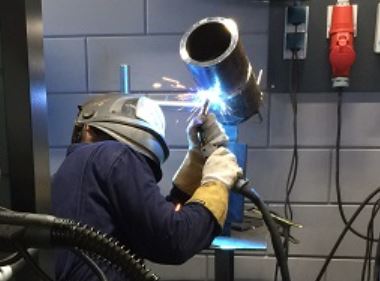
Welding for the 6G (L-H045) certificate.
By certifying multiple welders simultaneously, the cost per welder can be reduced.
Given the costs and the wide variety of certificates, it is therefore essential to make good and clear agreements with the companies about which certificate needs to be obtained.
A certificate that is valid for one company does not necessarily have to be accepted by another company.